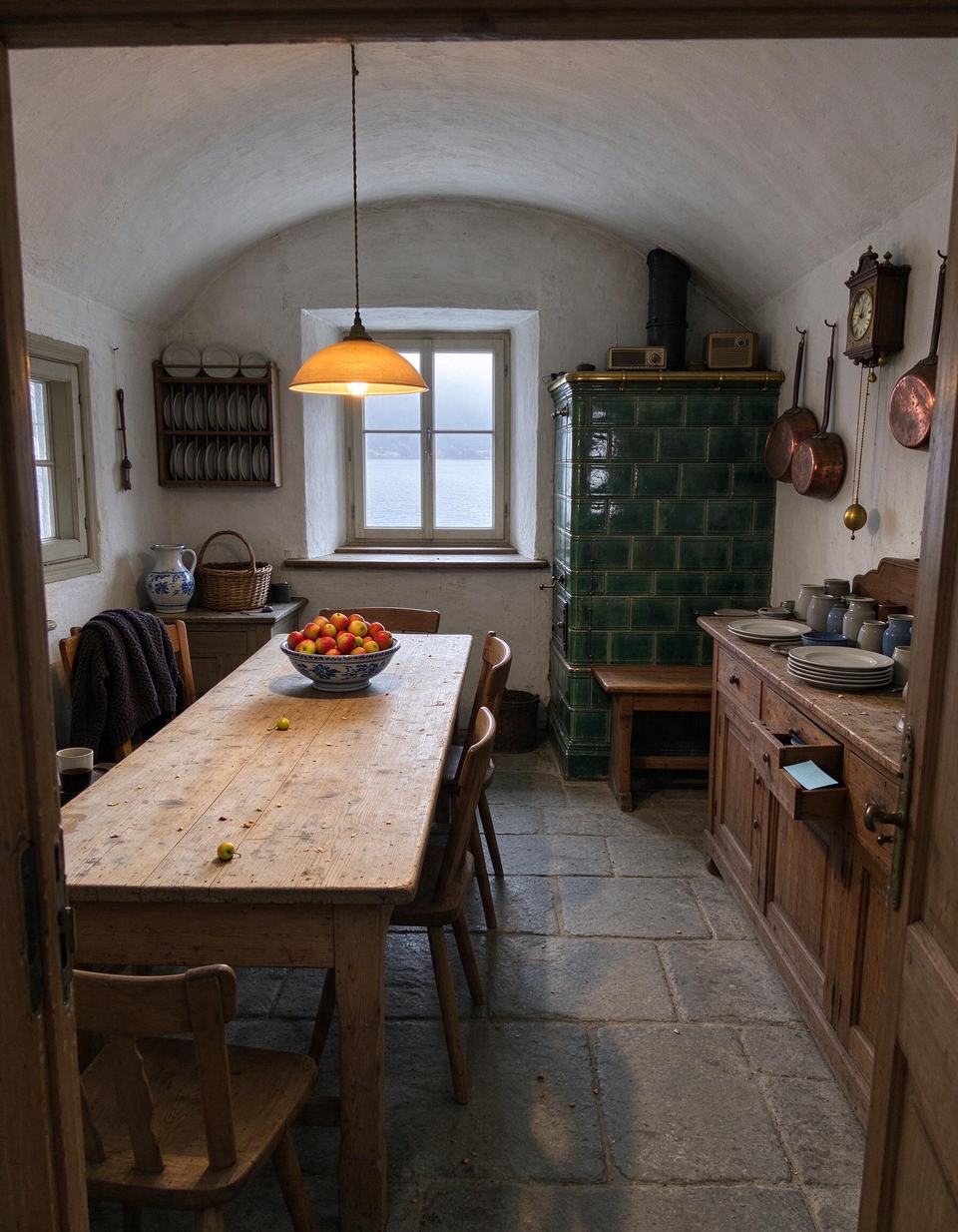
Leyla asked for three. I said the kitchen has about forty. She said three, Oma, people have phones. I gave her three. In November she came back for three more, so now there are six, and the rest stay in the drawer. Quantities are for four people or one grandson, unless it says otherwise. Weigh things. Nobody in this family who measured by eye is still alive. — C.
Reinanke, Müllerin (from the lake)
The Reinanke is the whitefish of the Attersee, silver, a little longer than your hand and a half, and it lives deep, at about twenty metres, where the water is four degrees. For fifty-eight years Hias brought them up to the kitchen door before seven, wrapped in yesterday’s paper, and would not come in. Now they come from a fisher in Unterach who scales them on the boat. Buy them the morning you cook them. Not in winter: that is when they spawn, and the fishers are busy hatching the eggs.
For 4
- 4 Reinanken of about 300 g each, gutted and scaled (char or trout if there is no Reinanke; the method is the same)
- salt, white pepper
- a small bunch of parsley, half of it whole for the fish, half chopped
- about 4 tablespoons plain flour on a flat plate
- 150 g butter
- juice of half a lemon
- for the potatoes: 600 g small waxy potatoes, a piece of butter, the chopped parsley
Put the potatoes on first, in their skins, in salted water; 20 to 25 minutes. Peel them while they are hot, which burns your fingers, which is correct.
Rinse the fish in cold water and dry them properly with a cloth, inside and out. Wet fish will not brown and the flour turns to paste. Salt and pepper the belly and push in a few sprigs of parsley. Salt the outside, turn each fish in the flour on both sides and knock off what does not want to stay.
Melt half the butter in a large pan (two pans if they do not fit; never overlap them) over medium heat, slowly, so it foams and does not brown. Lay the fish in and leave them alone. Six to nine minutes a side, depending on size, twelve to eighteen in all, until the skin is crisp and gold and the fin at the back pulls out with no resistance. Turn them once, with a fish slice and a spoon, never a fork, or the skin tears and the whole thing was for nothing.
Lift them onto warm plates. Pour the old fat out of the pan, put the rest of the butter in, let it foam, add the lemon juice and a pinch of salt, let it foam once more and spoon it over the fish. Parsley over everything. The potatoes go into the same pan for a moment with a piece of butter and the rest of the parsley.
In the Salzkammergut they also put the Reinanke on a stick over charcoal, Steckerlfisch, at every fair from here to Bad Ischl. That is a fair. This is a kitchen.
Summer 2004. Hias’s last summer with the boats. He came up the steps with four Reinanken on a Thursday in August, as he had since 1946, and stood at the door as he had since 1946, and I said sit down, Matthias, and for the first time in fifty-eight years he did. He ate one fish, slowly, and said it wanted more lemon. It did not. I have used more lemon ever since.
Tafelspitz with Apfelkren (winter)
Tafelspitz is the tip of the rump, a flat piece with a white cap of fat on one side; tell the butcher it is for boiling and that you want the fat left on. It is not a dish, it is an afternoon. The beef goes in at noon and the house smells of it until the next morning. What you get from it is three things: the soup first, then the meat, and the next day whatever you are clever enough to make of the rest.
For 6
- 1 Tafelspitz of about 2 kg, with its cap of fat
- 750 g beef bones, rinsed
- about 5 litres cold water
- 3 carrots, 3 yellow carrots (or parsnips), 1 small celeriac, all in large pieces
- 1 onion, unpeeled, cut in half
- 2 bay leaves, 10 black peppercorns, 2 juniper berries
- salt, at the end and not before
- chives
- for the Apfelkren: 3 sharp apples (Boskoop if you can), juice of half a lemon, a pinch of salt, a pinch of sugar, a piece of fresh horseradish root, 40 to 60 g once grated
Put the bones in the cold water in your biggest pot and bring it to the boil. Trim the skin and sinew off the meat but not the fat, and put the meat in with the bay leaves, pepper and juniper. From now on it must never boil. Keep it just below, so that the surface only shivers, for two to two and a half hours, and skim the grey foam off every time it comes. Do not salt it. Salt now makes the meat red and dry, and nothing you do afterwards brings it back.
Meanwhile put the onion halves cut side down in an old dry pan and let them go dark brown, nearly black. This is the colour of the soup. Add them with the vegetables to the pot and give it a little less than another hour, until a fork goes into the meat with almost no pressure. Lift the meat out, strain the soup, and let the meat rest in some of the soup while you make the Apfelkren.
Peel and finely grate the apples straight into a bowl with the lemon juice, so they do not go brown. A pinch of salt, a pinch of sugar. Peel the horseradish and grate it in last, at the table if you can, because it loses its strength in ten minutes and makes everyone in the room cry, which is part of the meal. Taste. It should be sweet first and then hit you.
Salt the soup now and serve it first, with chives, in cups. Then the meat, cut across the grain in slices as thick as a finger, on warm plates, a ladle of soup over it, coarse salt and chives on top, the Apfelkren beside it and roast potatoes if anyone has made them. Schnittlauchsauce is a separate religion and is not in this drawer.
Christmas 1994. Shirin’s first winter at the lake. She sat opposite me and asked, between the soup and the meat, a question nobody in this family had asked me in twenty years, and I answered it, because she had asked it plainly. Then she asked for this recipe. I gave her both. She is the only person I ever gave both.
Shirin’s saffron rice with tahdig (learned wrong, kept)
Shirin cooks when she is worried. Rice first, because the soaking takes an hour and gives her something to wait for. She learned it from her mother in Shiraz; I learned it from her at this table, badly, and she has corrected me every year since 1996. This is the wrong version. I prefer it. She knows.
For 4
- 400 g basmati rice
- salt, a great deal of it for the water, about 2 tablespoons for 3 litres
- a generous half teaspoon of saffron threads
- 3 tablespoons (45 ml) hot water
- 3 tablespoons full-fat plain yoghurt (Shirin: 2)
- 50 g butter for the bottom of the pot (Shirin: 60 ml neutral oil; this is the first wrong thing)
- 30 g butter, in pieces, for the end
- a heavy pot with a lid, not too wide, with a well-fitting bottom
Wash the rice in lukewarm water until the water runs almost clear; five or six changes. Cover it with cold water, add 2 teaspoons of salt and let it soak for at least half an hour, better an hour.
Bring 3 litres of water to a hard boil, salt it like the sea, drain the rice and tip it in. Stir once. It comes back to the boil in a few minutes; from then give it 5 to 7 minutes. Shirin says six. I say seven. The grain should be long, bent, soft outside and still with a bite in the middle. Drain it and rinse it briefly with cold water so it stops cooking.
Grind the saffron with a few grains of salt in a mortar and pour the hot water over it. Let it sit a minute until it is the colour of the lake at seven in the evening. Melt the 50 g of butter in the pot over medium heat. In a bowl mix the yoghurt with a tablespoon of the saffron water and a cupful of the parboiled rice, and spread this over the butter in an even layer, pressing it down a little. Pile the rest of the rice on top in a mound, not flat; with the handle of a wooden spoon poke five or six holes down to the bottom layer. Wrap the lid in a clean tea towel (so the steam does not drip back) and put it on firmly.
Medium-high heat for 6 to 8 minutes until you hear it sizzle and begin to smell the butter browning. Then the lowest heat you have, for 35 minutes. Shirin says 30. This is the second wrong thing, and it is why my crust is the colour of a chestnut and hers is the colour of gold. Take the pot off the heat, open it, scatter the rest of the butter and the rest of the saffron water over the top and let it rest, lid on, for five minutes.
Then the part everyone watches. A large plate over the pot, both hands, one movement, turn. If it comes out whole, say nothing and look as if it always does. If it does not, break the crust into pieces and lay them around the rice. It tastes the same. It is not the same. Shirin says this too.
October 2008. The men in suits came on a Tuesday with a laser measure and walked through the Saal. Shirin made rice that evening and the next and the next, three nights, the house smelling of saffron and butter and something burning slightly, and I stood next to her and learned it, and Konsti, twelve, sat on the stairs where he could see the front door and ate his from a bowl. The buyer withdrew a week before Christmas. The rice stayed.
Kaiserschmarrn (when it rains)
The story is that it was made for the Emperor, at Bad Ischl, on a hunt, or for the Empress, who did not eat it, or that a cook tore a pancake and was too proud to say so. These are stories. The word Schmarrn is older than any emperor, and so is the dish: woodcutters and dairymen cooked it in the pan and ate it out of the pan. In this house it is what happens on the third day of rain in July, when the children have read everything.
For 3, or 4 who had soup first
- 6 eggs, separated
- 360 ml milk
- 180 g plain flour
- 1 sachet vanilla sugar (8 g) and a pinch of salt
- 45 g sugar for the whites
- 50 g butter, melted, for the batter
- 45 g raisins, soaked in a spoon of rum, or in tea if there are children
- 60 g butter for the pan
- 2 tablespoons sugar with a little cinnamon, for the end
- icing sugar; Zwetschkenröster or apple sauce on the side
Whisk two thirds of the milk with the yolks, the vanilla sugar and the salt. Add the flour and stir until there are no lumps, then the rest of the milk and the melted butter. Beat the whites with the 45 g sugar until they are firm but still shine; they should stand, not crumble. Fold them in with a few big strokes. Stop while you can still see streaks of white.
Melt the butter in a wide heavy pan, 28 cm, over medium heat until it foams. Pour in the batter, about two fingers deep, and scatter the raisins over it. Let it set slowly with the lid half on until the underside is brown and the top is no longer liquid; this takes longer than you want. Cut it into quarters in the pan, turn each quarter and let the other side brown. If you are afraid of turning, put the pan in the oven at 200 °C for about 15 minutes instead, then cut and turn.
Now tear it. Two forks, not a knife, in pieces the size of a walnut, irregular, some bigger, some smaller; that is the point of a Schmarrn. Scatter the cinnamon sugar over it and toss it in the pan over higher heat for a minute or two until the edges catch and caramelise. Onto the plates, icing sugar through a sieve until it looks like the Höllengebirge in January, and the Röster beside it. Eat it from the pan if nobody is looking.
July, any year between 2003 and 2012. Konsti read the rain out loud from the window like a weather report, Leyla wanted to know whether the Empress had really refused it, and both of them tore the Schmarrn before it was ready. I let them. The torn edges are the best part, and children who are allowed to tear things in a kitchen grow up to cook.
Marillenknödel (summer)
The apricots have to be ripe to the point of being a problem. If they are hard, make something else and wait a week. The Wachau ones come at the end of July; ours, from the two trees by the wall, come in August and are smaller and better, and anyone who says otherwise has not had them.
For 16 to 18 dumplings
- 400 g Topfen (quark), 20 % fat, drained in a sieve for an hour
- 150 g plain flour
- 60 g butter, soft
- 1 egg and 1 egg yolk
- grated zest of half a lemon
- a pinch of salt
- 16–18 apricots
- sugar cubes, one per apricot, only if the fruit is sour
- 130 g fine breadcrumbs
- 120 g butter for the crumbs
- icing sugar
Cream the soft butter with the salt and the lemon zest. Work in the egg and the yolk, then the flour and the Topfen, and knead it only until it holds together. It is a soft dough and it stays soft. Cover it and leave it in the cold for three or four hours. I make it the evening before, which is the real recipe.
Push the stones out of the apricots with the handle of a wooden spoon, from the stalk end, so the fruit stays whole. If you must, put a sugar cube in the hole. Roll the dough into a log about 5 cm thick, cut it into slices, flatten each slice in your palm, set an apricot on it and close the dough around the fruit with your fingers. No cracks. The water finds cracks.
Simmer them in lightly salted water, never boiling, for 12 to 15 minutes. Move the pot now and then so they turn. In the meantime melt the butter in a wide pan, add the crumbs and toast them slowly until they are the colour of a good violin. Lift the dumplings out, let them drip, roll them in the crumbs and dust them with icing sugar. Eat them at once, at the table on the veranda, with the plate on your knees if there is no room.
Summer 2019. Leyla was nineteen and stoned apricots for two hours without complaining, which was new. The camera from the attic lay on the table between the fruit. I moved it twice. She moved it back. We ate fourteen dumplings between us and I did not tell her anything that year either.
Vanillekipferl (Christmas, our version)
The oldest written recipe for these is Katharina Prato’s, from the nineteenth century, and it has no egg in it. Neither does ours. Everyone else in Austria uses almonds. We use walnuts, from the tree behind the boathouse, which Hias planted in 1950 and which has never once asked for anything. The Kipferl come out darker and taste of something. The almond ones taste of icing sugar.
For about 50
- 280 g plain flour
- 200 g cold butter, in small pieces
- 90 g icing sugar
- 100 g walnuts, ground fine, toasted first in a dry pan until they smell of themselves
- 1 vanilla pod, split, seeds scraped out
- for rolling: 150 g icing sugar mixed with the seeds of a second pod, or two sachets of vanilla sugar if you are in a hurry, which at Christmas you are
Mix the flour with the ground walnuts. Add the butter and the vanilla seeds, then the icing sugar, and work it quickly with cold hands into a dough. Quickly. Warm hands make tough Kipferl; it is the only thing my mother ever said about baking. Press it into a ball, wrap it and leave it in the cold for an hour.
Roll pieces of the dough into ropes as thick as a finger, cut them into lengths of about 5 cm and bend each into a crescent with the ends thinner than the middle. Lay them on a tray with paper and leave space. Bake at 180 °C (fan) or 200 °C (top and bottom heat) for about 12 minutes. They should be pale on top and just going gold at the tips. People who bake them brown are punished by having to eat them.
Let them stand on the tray for two minutes, no longer, then turn them in the vanilla sugar while they are still warm. They break. Eat the broken ones; this is the baker’s wage. In a tin, with paper between the layers, they keep until Epiphany. They never last until Epiphany.
Christmas 1988. The first one after May. Ferdinand was fifteen and ate them off the tray before I had sugared them, which is the only correct way, and it was the first thing I had seen him eat properly since the boathouse. I made a second batch at eleven at night. The walnuts were from the tree his father had been standing under.
Lotte is fictional; the kitchen is invented, the recipes are not. Quantities and methods were checked against the sources below, then adjusted the way a grandmother would adjust them.
Sources
- Marillenknödel with Topfen dough (400 g Topfen, 150 g flour, 60 g butter, 1 egg + 1 yolk, 12–15 minutes), and the history of fruit dumplings in Austrian cookbooks from the mid-nineteenth century: Austrian Federal Ministry, register of traditional foods. bmluk.gv.at, Marillenknödel; the ORF “Guten Morgen Österreich” version for comparison (250 g Topfen, 100 g flour, 40 g butter, 2 yolks). extra.orf.at (PDF)
- Vanillekipferl, Viennese recipe with walnuts (280 g flour, 200 g cold butter, 90 g icing sugar, 100 g walnuts or almonds, 1 vanilla pod; rest 60 minutes; 200 °C / 180 °C fan, 12 minutes; roll warm in vanilla icing sugar). oma-kocht.de, Wiener Vanillekipferl; the almond standard for comparison (280 g flour, 210 g butter, 100 g almonds, 70 g sugar). kuechengoetter.de (PDF); Katharina Prato’s egg-free “Vanille-Kipferl” as the oldest known recipe, and the case for walnuts. falter.at, “Die Mutter aller Kekse”
- Saffron rice with tahdig: Andy Baraghani, The Cook You Want to Be (2022), as published by The Splendid Table: rice soaked in salted water, parboiled a few minutes after the return to the boil, bottom layer of parboiled rice tossed with yoghurt, oil and saffron water, 6–8 minutes medium-high until it sizzles, then 30–35 minutes low, rest 5 minutes, invert. splendidtable.org, Chelo ba Tahdig. Lotte’s butter, her extra yoghurt and her extra five minutes are hers.
- Reinanke, Müllerin: whole fish salted, floured, fried slowly in half of about 150 g butter without browning, 12–18 minutes in all depending on size, turned carefully; old fat poured off, the rest of the butter foamed with lemon juice and salt, parsley over. Renate Wagner’s “Saibling auf Müllerin-Art” for Austria’s national tourist office. austria.info, Saibling auf Müllerin-Art; the Upper Austrian version with 4 trout of about 300 g, parsley in the belly and 600 g potatoes boiled 20–25 minutes and tossed in butter and parsley. oberoesterreich.at, Forelle Müllerin; the Reinanke of the Attersee, caught in nets at about 20 m where the water is around four degrees, scaled on the boat, the fish for the Salzkammergut Steckerlfisch. oberoesterreich.at, “Die Fischerin vom Attersee”
- Tafelspitz for 6 (about 2 kg Tafelspitz with its fat cap, 750 g bones, about 5 litres cold water, carrots, yellow carrots, celeriac, an unpeeled onion browned dark on its cut side, 2 bay leaves, 10 peppercorns, 2 juniper berries; 2 to 2½ hours just below the boil with skimming, then the vegetables and a little under an hour more; no salt while it cooks, or the meat turns red and dry). Vienna Tourist Board. wien.info, Tafelspitz; Apfelkren (apples peeled and grated, lemon juice or vinegar and a pinch of salt, freshly grated horseradish, sugar to taste) and the fork test. steirische-spezialitaeten.at, Gekochtes Rindfleisch mit Apfelkren
- Kaiserschmarren, per portion 120 g milk, 40 g yolk, 60 g flour, 60 g white beaten with 15 g sugar, 30 g butter in the batter and 30 g in the pan, 15 g raisins; set over moderate heat, quartered and turned (or 15 minutes in the oven, then cut and turned), torn, caramelised with cinnamon sugar; Zwetschkenröster or apple sauce. Lotte’s version is three portions. The history of the word (first recorded 1563) and the imperial legends, which the register itself calls legends: Austrian Federal Ministry, register of traditional foods. bmluk.gv.at, Kaiserschmarren